

Are you allowed to rest, or do you have to earn it?
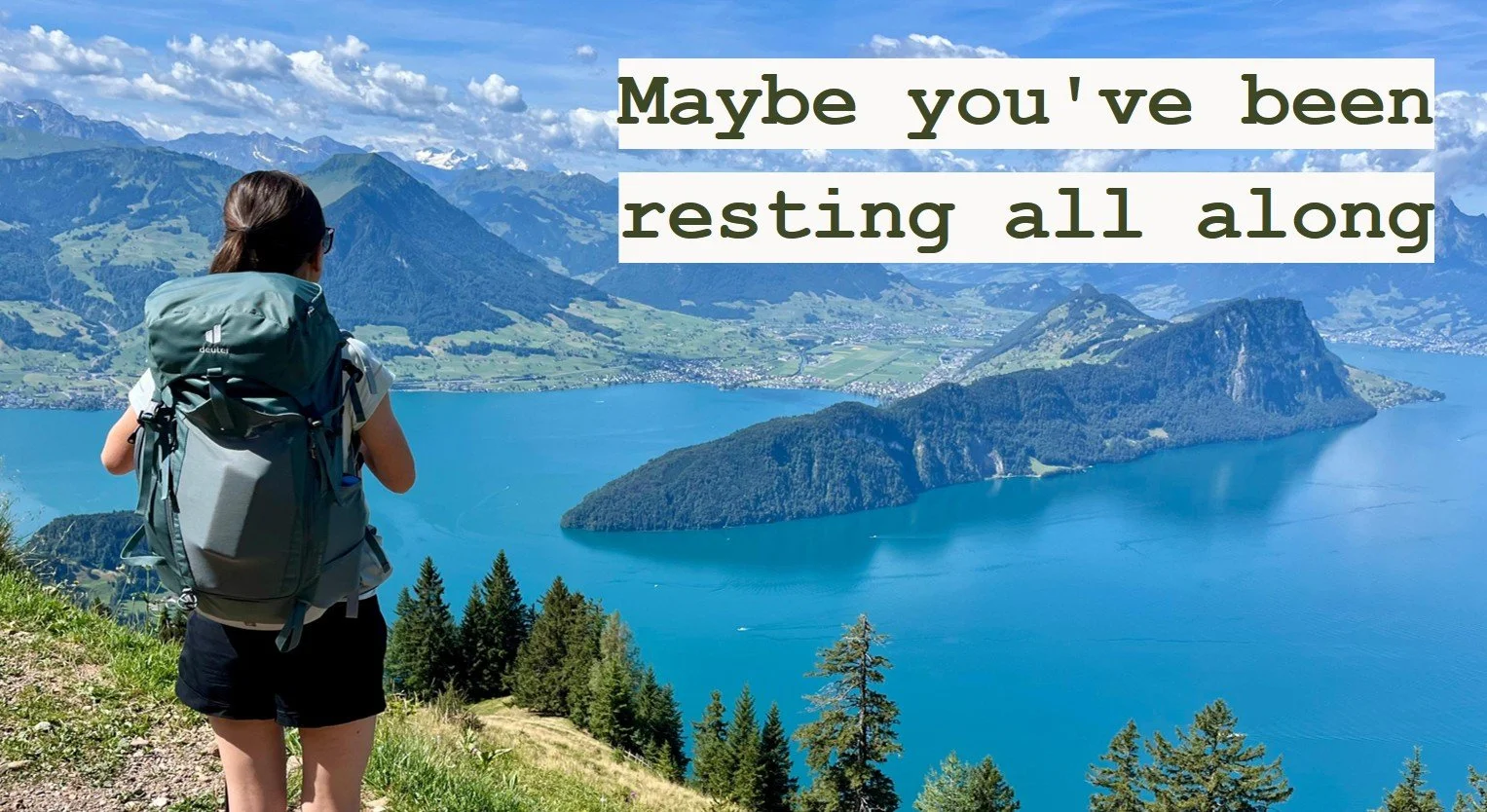
When you sit down without a task at hand, does a small voice start listing everything you should be doing instead?
I'm pretty sure you know that voice too. It's one of the most common threads I see with my clients and in my circle. So many of us have lost the ability to enjoy what we already have, without needing it to lead somewhere.
Why stillness doesn't work for me
I wish I could say I've mastered this myself. Meditating, sitting quietly, walking with no destination, listening to music with no chores at hand. None of that comes naturally to me. The moment I try, my mind treats it as an invitation to replay the day and get a head start on tomorrow.
That forced stillness isn't calming for me. It's not recovery. Quite the opposite. It feels stressful, and my inner critic does more damage than good.
Am I bad at mindfulness, or is my definition of it too narrow? Is there a way of finding presence other than by being still?
The one place where I do switch off is running. When I run, I can't do much else besides being with my thoughts, or with no thoughts at all. What comes up is kind, creative, happy. I'm not out there to compete, but running brings physical and mental health benefits. My brain accepts that as a purpose, and the noise quiets down.
Years ago, I realized that purpose wasn't getting in the way of my rest. It was giving me permission to rest.
Then, only recently, something else became clear. While I can't create stillness on demand, I've been scheduling it all along, just not in the form I'd pictured for downtime. I plan small and big things I do with my husband, family, and friends. A hike. A drink in the garden. Dinner with people I don't have to perform for.
Ordinary stuff. But what makes it precious: During those moments, I'm not worrying, not running my to do list in the background, not thinking about what's next, not rushing. There's no guilt about being unproductive. I'm simply there. Present. Talking, listening, laughing.
I thought running was my only real break. It turns out I had built many small islands where I could simply be. Looking at it, that makes total sense. Connection and meaningful relationships have always mattered deeply to me. They seem to give my brain the same permission running does. My mind doesn't fight those moments the way it fights stillness.
Coaching has shown me that many people do the exact same things and still don't get any rest from them. They can't let go. Their minds stay on the to-do list. They rush through, still worrying, never fully arriving in the moment.
It's clearly not about what you do.
When did you last forget to worry about being productive?
When there are no islands
For many of us, especially high achievers, those islands of being barely exist. Every day becomes another stretch of productivity, responsibility, and obligation, with nowhere to land and recover. And when they do try to slow down, guilt often appears almost immediately.
Do you recognize yourself in this?
The self-talk rarely stops at one sentence. It escalates.
I shouldn't be sitting here. I don't really deserve a break yet. I'm lazy. For some, it goes even deeper: I'm a failure. I'm worthless.
So we stay busy. Running errands, staying ahead of the to-do list. Since recovery is for the weak.
Different lives, same pattern
From my work, my reading, and what I observe around me, so many people are caught in endless motion. Parents who rarely get a break. Professionals who've achieved everything they once wanted, yet still struggle to switch off. Job seekers who believe they haven't earned a moment of rest until the next offer arrives. People caring for aging parents or other dependents around the clock.
Different situations, same underlying pattern: constant output, one finish line immediately replaced by another, and an inner commentary far harsher than anything we'd say to a friend.
We rarely take the time to understand what we want, need, or already have. We live in a time of comparison, and because there's always someone who seems to have more, we never stop. We keep chasing the next goal, the next title, the next milestone, the next "more," without asking whether it was ever ours to begin with.
This is one of the reasons I care so deeply about my work. A surprising amount of what wears us down, and sometimes what eventually tips into psychological strain, begins much earlier than we realize. Often, it starts with never pausing. Never looking inward. Never questioning whether the standards we live by are our own.
Most people don't need a different life. They simply need to notice, protect, or create those islands before they disappear altogether.
The reframe that changes everything
Rest that feels like "doing nothing" rarely survives in an achievement-driven mind. Rest that serves a purpose tends to get through, and this isn't just a personal take.
Psychological research supports this. When the same leisure activity was reframed as serving a clear function, much of the enjoyment returned.
If your brain needs a reason to pause, that's not cheating. For some of us, it's what makes rest possible in the first place.
There are people who can sit quietly and feel completely restored. Others need to give themselves permission to rest. Sometimes that permission comes from purpose. Sometimes it comes from doing something that aligns with what you value, a belief, a relationship, or a part of who you are. I seem to need both.
A break can help us:
recover physically and mentally from stress and fatigue
create distance from whatever feels overwhelming
see challenges from a fresh perspective
think more creatively
solve problems more effectively
return with greater clarity and focus
If knowing the benefits makes it easier for you to take that break, start there.
Give yourself permission
Small, doable steps go a long way. Build a few 'being' moments into your week by picking one activity with nothing to prove. Put it on your calendar like any other recurring commitment and allow yourself to do just that.
If traditional rest leaves you restless, don't force yourself to copy someone else's version of recovery. Instead, ask yourself a different question: What gives my brain permission to let go?
For me it's running or spending time with my people. For you it might be:
Sitting with your tea or coffee for ten extra minutes.
A walk with no destination.
A conversation with someone you love.
Tending plants.
Any kind of movement that isn't about performance.
Cooking, painting, or another creative pursuit.
Time with a pet, should you have one.
Meditating, if that's your thing.
It doesn't really matter what you do. If it allows you to stop worrying about what's next and simply be where you are, you've probably found one of your islands.
What usually doesn't help is more input. Endless scrolling, television, or constantly checking your phone doesn't create real presence.
Commit to your chosen window the way you'd commit to someone else. If guilt shows up when you rest, greet it rather than obey it.
Guilt is an emotion, not an instruction.
Remind yourself of the benefits of a mental break and notice what you tell yourself. If it's harsh, ask yourself: would I say this to a close friend? If not, decide what you'd say instead, and tell it to yourself. Out loud, if you can.
Maybe your island won't look like anyone else's. That's fine. It only has to be restorative to you.
What worries me most
Seeing that struggle in clients who look composed but are quietly running on empty is one of the things that worries me most. Pushed too far for too long, it doesn't stay harmless. It can tip into something that takes much longer to heal from.
It's one of the reasons I started a postgraduate program this year, a Certificate of Advanced Studies in goal-oriented counseling for people affected by psychological conditions, taught by practicing psychologists and psychiatrists.
I'm not becoming a therapist, and I don't diagnose or treat. What I'm gaining is a deeper foundation to recognize patterns and warning signs of mental illness. My goal is to better understand what clients may be carrying beneath the surface, especially those with a history of, or tendency toward, burnout or depression.
Many high achievers are used to running on willpower. But the very determination that helped them succeed is often what makes them ignore their own red flags. Sometimes they don't yet have the awareness or the words for what's happening, and I can gently raise the question or name what I notice.
Coaching is about helping people grow. This counseling training adds a layer underneath it: tools to name what's motivating or blocking change, activate the resources someone has, and help them face what is painful so we can build from solid ground, rather than around it.
Who's the person in your corner?
One finding from my studies felt reassuring: decades of research on what makes psychotherapy and counseling work point to the same conclusion. One of the strongest predictors of a positive outcome isn't a specific technique. It's the quality of the relationship between client and their practitioner, grounded in presence, authenticity, unconditional positive regard, and empathy, as well as their ability to show up for the person in front of them.
It confirmed something I've believed throughout my coaching career: people often find the courage to be fully themselves, not become someone new, when they feel seen, understood, and safe. Sometimes that's a coach, sometimes a counselor or therapist, sometimes a trusted friend.
Who's that person for you? Do you have someone you can be open with, without filtering yourself first?
So much can be softened, and even prevented, by staying close to someone who sees you.
You don't have to earn rest
You don't have to rest the way anyone else does. You only need to find what gives you permission to do it.
When did you last do something simply because you enjoyed it, not because it was getting you somewhere?
If this resonates and you'd like a space to explore what enjoying your life could look like for you, I'd love to talk. This is the kind of work I do with clients in the Insight Track, my long-term coaching partnership built for this depth.
Keep shining,
Yvonne
#IntentionalLiving #SelfAwareness #Rest #BurnoutPrevention #EmotionalWellbeing #LeadershipCoaching #PersonalGrowth
