

Active listening matters more than speaking well
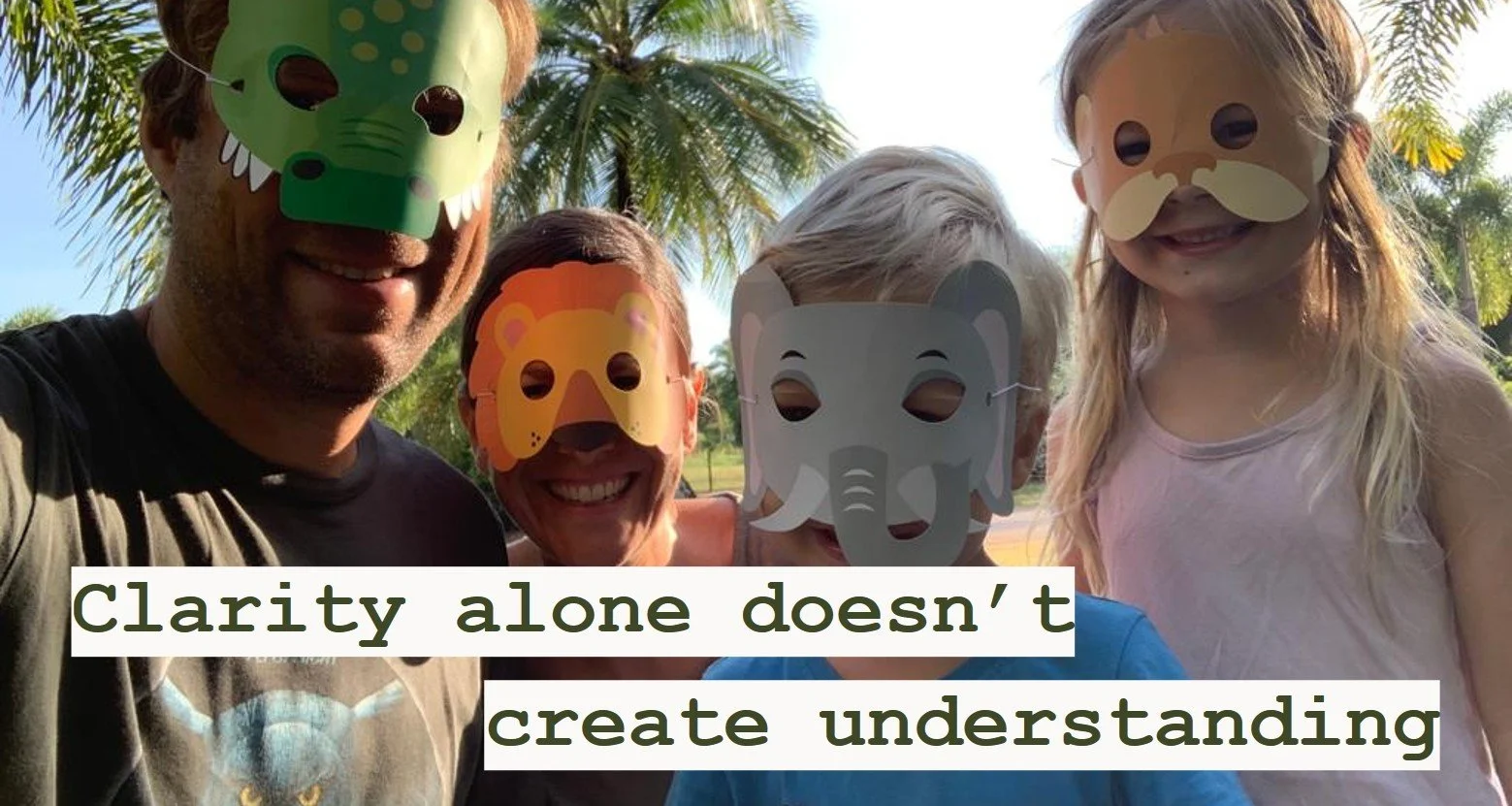
Especially when we all wear different masks
Active listening is often treated as a soft skill. Nice to have, but secondary. In reality, it is one of the most decisive leadership capabilities we have. It determines whether meaning lands, trust builds, and people feel seen.
Meaning gets lost easily
Our family language is English. Our children also speak French, German, and Swiss German. Playing a game, our son was confused about the rules, which we clarified.
He says: OK, got it. I’ll write it behind my ears.
I did not react. My French husband looks at him and asks: What will you do?
Our son repeats the sentence. I realize what is happening and smile.
With a big grin, I say to my husband: Now, we have the salad.
And he starts laughing, because this German idiom, he knows well.
For those of you who speak German, you are with me. For the rest of you, a short explanation. In German, when we want to remember something, we say: Ich schreib’s mir hinter die Ohren. Word for word, this translates to “I’ll write it behind my ears”. ***
Nun haben wir den Salat (now, we have the salad) is another expression meaning: now, we’ve got a mess on our hands.
Being clear is not the same as being understood
Languages often get mixed up in our household, and I love every bit of it. It brings creativity, mind expansion, insightful exchanges, and a lot of laughter along the way.
The story above stayed with me because it mirrors how often we say something that makes perfect sense to us but confuses the person in front of us.
It is a reminder to assume less and to crosscheck when something does not quite add up.
This dynamic shows up far beyond family life. You will find it everywhere.
When we think we know
Reading between the lines has become more important to me, but in a different way. We are often quite good at reading the air, especially when we are around people of our own nationality, region, or background. And yet, this is exactly where we tend to assume too much.
Because we think we know, we stop checking. We do not dig deeper but fill in the gaps ourselves.
Sometimes that works. Often, it leads to misunderstanding, frustration, or hurt.
Especially in leadership and professional contexts, assumptions can be costly. Power, hierarchy, cultural norms, and unspoken expectations amplify the risk of getting it wrong.
Cues like eye contact, gestures, what has not been said, and the choice of words are important to take note of. But what is probably most crucial is to crosscheck our understanding.
This is where active listening becomes essential.
Active listening as a leadership skill
Active listening is the conscious, intentional practice of fully focusing on, understanding, responding to, and remembering a speaker’s message, both verbal and nonverbal. It goes beyond hearing words. It requires suspending judgment, offering presence, and giving feedback so the other person feels heard and understood.
Active listening often looks surprisingly simple:
Repeating what you heard in your own words
Summarizing key points to confirm shared understanding
Asking clarifying questions like: What do you want me to do? or What do you mean by that?
Naming what you observe or notice emotionally and addressing it: It looks like this is frustrating for you. Did I get that right?
Making assumptions explicit and inviting correction: I might be assuming here, is it correct that...?
These small acts slow conversations down in the best possible way.
Your counterpart will feel seen and taken seriously. By showing a genuine willingness to understand, you also signal that questions are welcome and not a sign of incompetence.
This does not only improve performance. It strengthens relationships, builds trust, and creates environments where people feel safe to speak up. Active listening is empathy in action and emotional intelligence made visible. And very often, people start mirroring it.
Reading between the lines has become more important to me in a different way. Not to assume meaning, but to slow down, listen more intentionally, and stay curious a little longer.
This mindset has shaped how I show up in complex conversations, and how I work with leaders and professionals navigating uncertainty, tension, and change. When we stop rushing to interpret and start checking what we heard, conversations shift, trust grows, and decisions become clearer.
What small moments in your daily life invite you to pause, check, and listen more carefully?
Hi, I'm Yvonne 👋
I support experienced professionals in making meaningful career choices and navigating growth, transitions, and leadership challenges.
If you’d like a thoughtful space to reflect, gain clarity, and shape what comes next, you can learn more about my coaching approach here.
*** I read up on the expression “to write it behind your ears” since it seemed entirely random:
Historically, when literacy was not widespread, important events such as defining property boundaries or finalizing contracts had to take place in front of witnesses. To ensure that younger witnesses would remember these moments even decades later, their ears were sometimes pulled or they were given a box on the ears.
The painful sensation was meant to anchor the memory deeply. The information was, quite literally, “written” into their minds. Fortunately, today we only write things behind our ears metaphorically, without anyone needing to resort to violence.
#ActiveListening #LeadershipCommunication #EmotionalIntelligence #CrossCulturalLeadership #Empathy
